Spelling Rules
Below are rules for spelling changes that may apply when attaching an ending to a stem. These are not exceptions: they consistently apply when certain letters combine. Some rules preserve the intended pronunciation of the verb form, while others involve small pronunciation changes.
Pronunciation-Preserving Rules
These rules do not change the pronunciation of the verb form: rather they prevent pronunciation from changing. These spelling changes do not make a verb irregular.
- hard g → gu before e/i: When the stem ends in a hard g (as in gato), insert a silent u before e or i to preserve the hard g sound: pag + e → pague.
- hard c → qu before e/i: When the stem ends in a hard c (as in cat), write qu instead of c before e or i to preserve the hard c sound: toc + e → toque.
- soft g → j before a/o: When the stem ends in a soft g (as in jota), replace g with j before a or o to preserve the jota sound: escog + o → escojo.
- soft c → z before a/o: When the stem ends in a soft c (as in zeta), replace c with z before a or o to preserve the zeta sound: venc + o → venzo.
- z → c before e/i: When the stem ends in a z, replace z with c before e or i (z is avoided before i/e in Spanish): cruz + e → cruce.
- gu → gü before e/i: When the stem ends in gu with a pronounced u (as in -guar verbs) and the ending starts with e or i, put a dieresis on the u so that the u is pronounced and the g stays hard: averigu + e → averigüe.
- stressed i → í after vowel: When the stem ends in a vowel and the ending begins with a stressed i (·imos, ·iste, ·isteis, ·ido, ·ir, and ·id endings), accent the i so it remains its own syllable and does not form a diphthong with the stem vowel: ca + imos → caímos (not "caimos", which would be two syllables instead of three).
Unstressed Initial i Rules
The following spelling rules apply when the ending begins with an unstressed i (·ió, -iendo, ·ieron, ·iera, ...). These rules either remove or change the i to a y, resulting in subtle changes to the verb form's pronunciation that reflect general Spanish sound patterns.
- unstressed i → y after vowel: When the stem ends in a vowel other than i and the ending starts with an unstressed i, the i becomes the consonant y: le + ió → leyó.
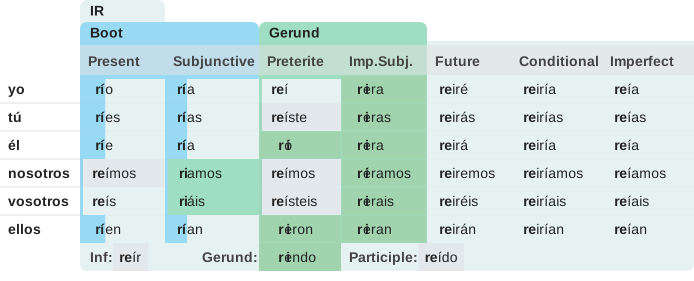
- drop unstressed i after i: When the stem ends in a i and the ending starts with an unstressed i, drop the ending's i: ri + iera → riera.
- drop unstressed i after y, ll, and ñ: When the stem ends in a palatal consonant y, ll or ñ and the ending starts with an unstressed i, drop the i: bull + iendo → bullendo.
Vowel-Ending Stems
When the stem of an ·er/·ir verb ends in a vowel, such as in leer, caer, reír and oír, the initial i rules rules apply to many forms: most of the preterite, all of the imperfect subjunctive, the gerund, and the infinitive for ·ir verbs.
Which rule applies depends on whether the i in the ending is stressed or unstressed. An unstressed i is either dropped (after i or palatal consonants y, ll, and ñ) or converted to a y (after other vowels). A stressed i is replaced with an í (with an accent). This is why reír and oír have an accent mark in the infinitive: the initial -i in the ·ir ending is always stressed.
Tip: Which Syllable is Stressed
Recall that in Spanish, the following rules determine which syllable receives the stress:
- The syllable with the accent mark, if any
- The second-to-last syllable if the word ends in a vowel, n, or s
- The last syllable if the word in any consonant other than n or s
As a consequence of these rules, the initial i is usually stressed in the following endings: ·imos, ·iste, ·isteis, ·ido, ·ir, and ·id.
But when these endings are preceded by a vowel, the un-accented i would form a diphthong with the preceding vowel, instead of being pronounced as its own stressed syllable. The stressed i → í after vowel ensures these endings are pronounced the same way no matter what the stem.